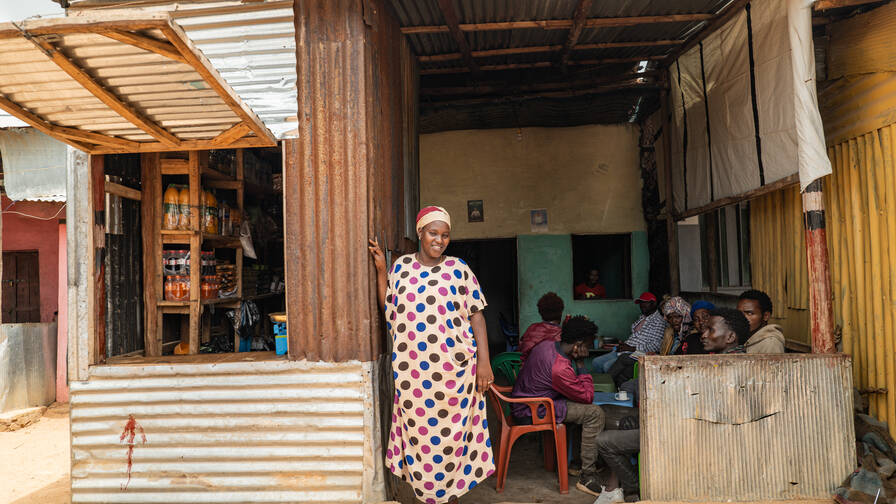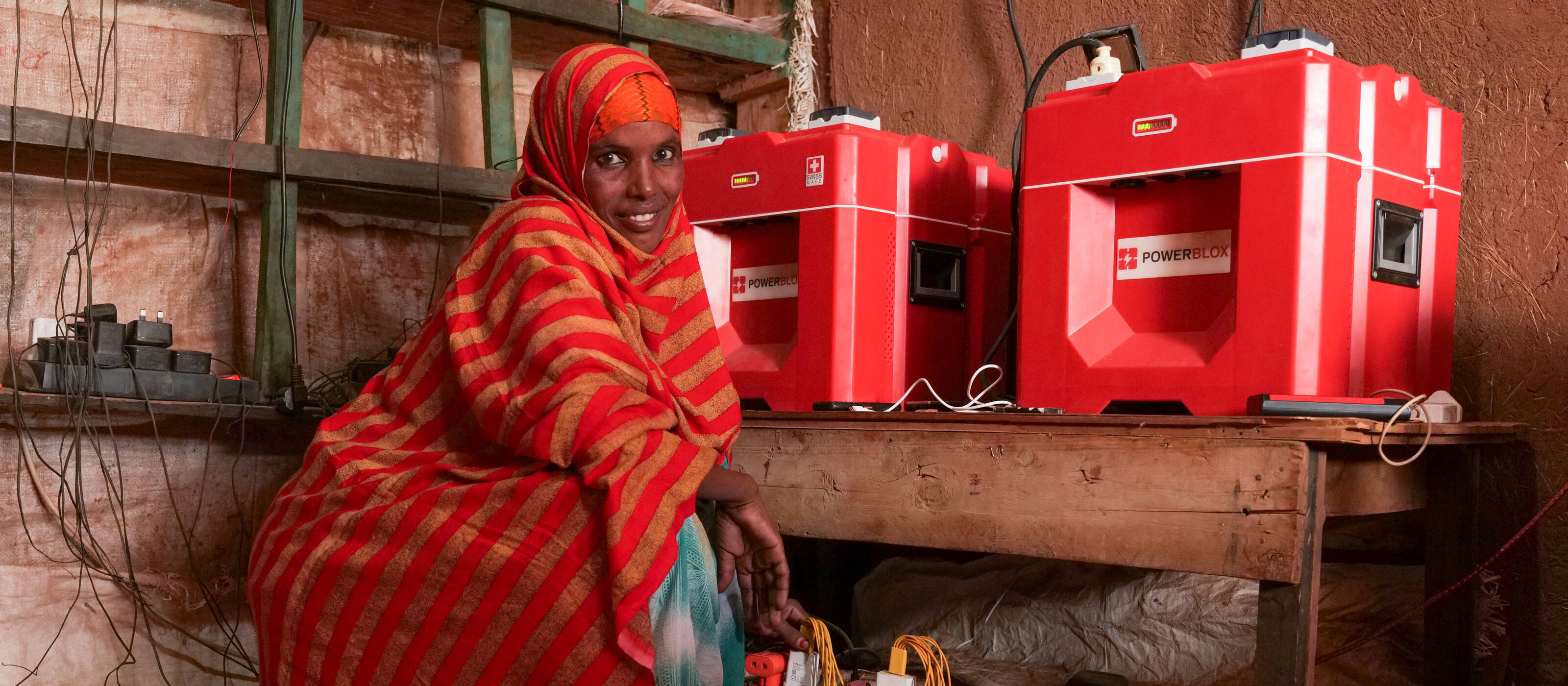
Tayiba Hasan lives in Ethiopia and earns her income from a small store. But the money is not enough for her family of six. The irregular and expensive electricity supply makes her everyday life even more difficult. Since Tayiba has been able to obtain solar power through a Caritas project, her life has been easier. The mother of five has been able to expand her business and now charges people's cell phones for a fee, thus increasing her income.

Energy for rural start-ups - access to and efficient use of electricity

finished

Projet in Ethiopia
-

Access to energy is essential for sustainable development and poverty reduction. To achieve global electricity access by 2030, the electrification rate must be tripled. Although solar energy is booming, sustainable energy storage is often neglected, leaving potential untapped. In Ethiopia, rural communities are particularly disadvantaged: Only 14% have access to electricity, even though pastoral areas make up 60% of the country. Their needs are hardly taken into account in national policy.

Facts and figures

Topic

Climate

Budget

1'000'000 Swiss franc

Project Area

Ethiopia, Oromia Region

Target Groups

Start-ups, small businesses and co-operatives

Duration

01.07.2021 - 31.12.2024

Project in detail

Access to energy is an essential prerequisite for the realisation of many sustainable development goals. The goals go far beyond the energy sector: overcoming poverty, promoting the economy or the advancement of women, increasing food production, improving public health, etc. Because sustainable development requires climate-friendly economic development, the share of renewable energy in the global energy mix should be significantly increased. In order to achieve the goal of universal access to electricity by 2030, the current electrification rate would have to be tripled. In recent years, many initiatives and falling costs for solar modules have led to the promotion of solar-powered systems, while (sustainable) energy storage has largely been left out of off-grid solutions, leaving access to temporary electricity supply and potential for electrification
unrealised.

The pastoral areas in the Ethiopian lowlands cover around 60% of the country. Nevertheless, the pastoral and agro-pastoral communities (approx. 12-15 million people) are often marginalised and national policies hardly address their needs. While general grid access to electricity in Ethiopia has reached 44% (2022), only 14% of the country's pastoral and agro-pastoral communities have access to electricity.

This project consistently promotes energy efficiency and the use of renewable energies in order to improve the living conditions of the target groups. Through access to storable solar energy, thanks to the Powerblox swarm battery/nano-grid technology developed in Switzerland, and suitable business models, innovative small businesses and cooperatives, as well as health centres and schools, are given the opportunity to increase their income and improve their services. The aim is to develop a business model that offers the rural population sustainable access to the technology and associated services.

In this first pilot phase, 87 Powerblox with associated solar modules were installed and the 15 small businesses, 2 cooperatives and 7 public institutions that purchased them were supported in their implementation. By June 2024, it was clear that the energy was mainly being used for lighting, charging IT devices (mobile phones, computers, TVs), office and laboratory equipment and shavers. In addition to increased income for the 78 business owners, 49 new jobs were created. The health centres can also report average weekly cost savings of 43 USD, as they no longer use the diesel-powered generators, or use them less. The small businesses also provide electricity to neighbouring households, enabling social and productive activities in the
evenings.

Only ten months after commissioning, all the farms had paid back their share of the costs for the technology, which illustrates the financial profitability. The knowledge gained about effectiveness and profitability is helping to increase acceptance and interest in the new technology among stakeholders such as the Ethiopian Government, donors and  investors. Once the successful pilot phase has been completed, the focus will be on scaling up the project and slowly transferring it to a private sector model: however, before Powerblox can be made available in large numbers and at more favourable prices, further investment capital is required

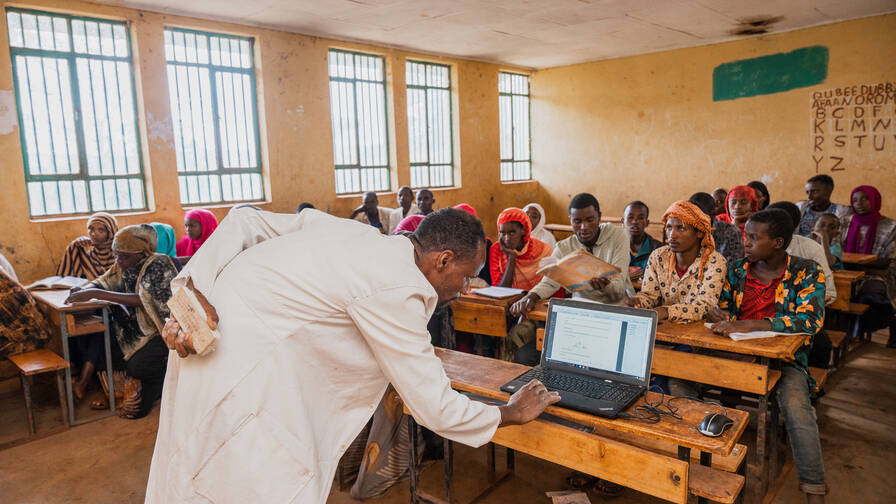
Thanks to Power-Blox, schools can now also use digital media in lessons, print materials directly at school and offer evening classes for adults.
Thanks to Power-Blox, schools can now also use digital media in lessons, print materials directly at school and offer evening classes for adults. © Resolution
1 / 3
Michu Jilo also uses the Power-Blox from Caritas Switzerland. She has a restaurant and coffee shop, an integrated kiosk and also trades with electricity: charging cell phones, electricity for 2 neighboring houses and her own.
Michu Jilo also uses the Power-Blox from Caritas Switzerland. She has a restaurant and coffee shop, an integrated kiosk and also trades with electricity: charging cell phones, electricity for 2 neighboring houses and her own. © Ayaana Publishing
2 / 3
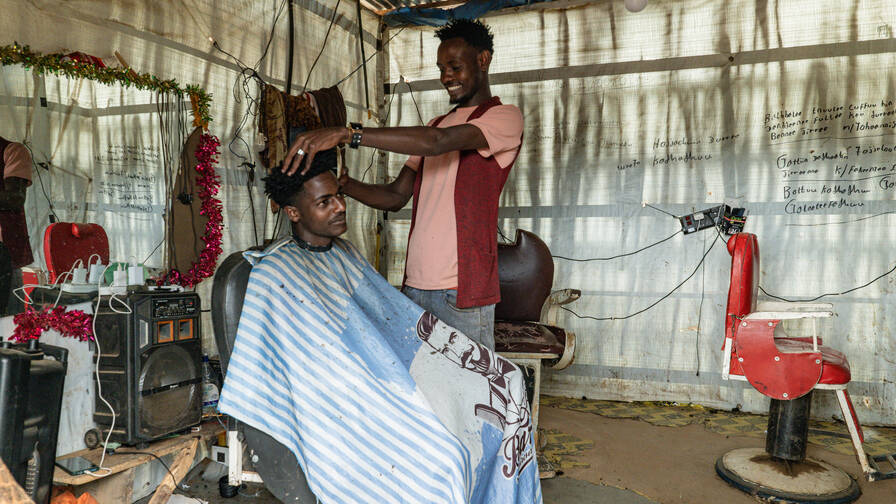
The barbershop used to run on a generator. This wasted a lot of energy for a small power consumption. With solar power from the Power-Blox, they can use exactly as much electricity as they need in the barbershop at any given time - and it's cheap and sustainable.
The barbershop used to run on a generator. This wasted a lot of energy for a small power consumption. With solar power from the Power-Blox, they can use exactly as much electricity as they need in the barbershop at any given time - and it's cheap and sustainable. © Ayaana Publishing
3 / 3
Thanks to Power-Blox, schools can now also use digital media in lessons, print materials directly at school and offer evening classes for adults.
Thanks to Power-Blox, schools can now also use digital media in lessons, print materials directly at school and offer evening classes for adults. © Resolution
1 / 3
Michu Jilo also uses the Power-Blox from Caritas Switzerland. She has a restaurant and coffee shop, an integrated kiosk and also trades with electricity: charging cell phones, electricity for 2 neighboring houses and her own.
Michu Jilo also uses the Power-Blox from Caritas Switzerland. She has a restaurant and coffee shop, an integrated kiosk and also trades with electricity: charging cell phones, electricity for 2 neighboring houses and her own. © Ayaana Publishing
2 / 3
The barbershop used to run on a generator. This wasted a lot of energy for a small power consumption. With solar power from the Power-Blox, they can use exactly as much electricity as they need in the barbershop at any given time - and it's cheap and sustainable.
The barbershop used to run on a generator. This wasted a lot of energy for a small power consumption. With solar power from the Power-Blox, they can use exactly as much electricity as they need in the barbershop at any given time - and it's cheap and sustainable. © Ayaana Publishing
3 / 3
Thanks to Power-Blox, schools can now also use digital media in lessons, print materials directly at school and offer evening classes for adults.
Thanks to Power-Blox, schools can now also use digital media in lessons, print materials directly at school and offer evening classes for adults. © Resolution
1 / 3
Michu Jilo also uses the Power-Blox from Caritas Switzerland. She has a restaurant and coffee shop, an integrated kiosk and also trades with electricity: charging cell phones, electricity for 2 neighboring houses and her own.
Michu Jilo also uses the Power-Blox from Caritas Switzerland. She has a restaurant and coffee shop, an integrated kiosk and also trades with electricity: charging cell phones, electricity for 2 neighboring houses and her own. © Ayaana Publishing
2 / 3
The barbershop used to run on a generator. This wasted a lot of energy for a small power consumption. With solar power from the Power-Blox, they can use exactly as much electricity as they need in the barbershop at any given time - and it's cheap and sustainable.
The barbershop used to run on a generator. This wasted a lot of energy for a small power consumption. With solar power from the Power-Blox, they can use exactly as much electricity as they need in the barbershop at any given time - and it's cheap and sustainable. © Ayaana Publishing
3 / 3
Your donation for the project
Your data is safe with us.

Further projects Commitment to a world without poverty

View all

Fundet through:

  • SDC
  • Caritas Switzerland

A fundraising  strategy is being developed with the Partner Powerblox for scaling up.

Header image: Tayiba Hasan lives in Ethiopia and earns her income from a small store. But the money is not enough for her family of six. The irregular and expensive electricity supply makes her everyday life even more difficult. Since Tayiba has been able to obtain solar power through a Caritas project, her life has been easier. The mother of five has been able to expand her business and now charges people's cell phones for a fee, thus increasing her income. © Ayaana Publishing